Understanding the Chicago South Side Multifamily Market in 2026 with Jesus Garcia

The Chicago South Side multifamily market rewards disciplined investors who understand supply-demand fundamentals, operational execution, and realistic underwriting. Today Essex Realty Group Director Jesus Garcia breaks down what is happening across the South Side today and what investors should focus on when evaluating opportunities.
Market Activity and Transaction Volume
Over the past 24 months, the South Side has seen consistent multifamily transaction activity:
- 458 multifamily properties traded
- $626 million in transaction volume
- More than 7,100 apartment units sold
Source: CoStar data analyzed by Essex Realty Group
This is not speculative froth. It is steady investor activity centered on attainable workforce housing and durable cash flow rather than aggressive appreciation assumptions.
Where the Chicago Multifamily Market Sits in the Current Cycle
Markets move in cycles. Glenn Mueller’s Market Cycle framework identifies four phases: recovery, expansion, hypersupply, and recession. Understanding where a market sits helps investors calibrate expectations around rent growth, occupancy, and future competition.
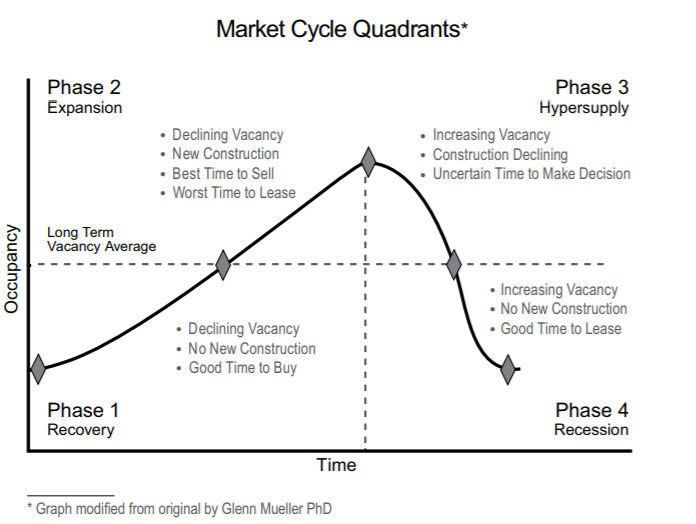
Chicago multifamily today: Early expansion phase across most submarkets.
- Vacancy remains relatively healthy
- Stabilized buildings continue operating near full occupancy
- Rent growth has moderated from post-pandemic highs but remains positive
The South Side supply story is also materially different from many national markets. Outside a handful of larger developments, new construction activity remains relatively limited. Most recent inventory additions continue to be smaller-scale 4–5-unit projects rather than the large institutional supply waves impacting several Sun Belt markets.
That distinction matters. While neighborhoods such as River North, West Loop, and Lincoln Park continue seeing active development pipelines, much of the South Side remains supply constrained, supporting demand for existing apartment inventory.
National Housing Shortage Continues Supporting Multifamily Demand
The broader national housing shortage continues influencing apartment demand locally.
- The United States remains undersupplied by approximately 3.7 million housing units according to Freddie Mac
- Current annual housing production remains near 1.35–1.4 million units per year
- Industry estimates suggest the market needs approximately 2.0–2.2 million units annually for the next 5–7 years to close the gap
- That represents annual underbuilding of roughly 600,000–850,000 housing units
Locally, this continues supporting demand for South Side apartment inventory. Garden units that rented for approximately $750–850 per month several years ago now commonly begin closer to $1,000 per month in many neighborhoods. This shift has largely been driven by gradual market repricing and broader affordability pressures across Chicago rather than aggressive rent increases alone.
Cap Rate Stability Despite Higher Interest Rates
One of the more notable trends across the South Side has been cap rate stability despite broader national multifamily repricing.
Over the past two years, many South Side multifamily assets have continued trading near the 9% cap rate range even as interest rates increased significantly.
Several factors have contributed to that relative stability:
- South Side multifamily has historically been underwritten differently than core urban luxury markets
- Investors in these neighborhoods typically prioritize durable cash flow and current income over aggressive appreciation assumptions
- That more disciplined basis helped avoid some of the sharper pricing corrections seen in other multifamily sectors
According to Elliott Quigley of Essex Capital Markets, lenders today are placing greater emphasis on debt yield metrics and in-place cash flow durability rather than relying heavily on historical loan-to-value assumptions.
That shift reflects a broader market focus on repayment certainty, cash flow stability, and downside protection.
Operational Execution Separates Strong Investments
The South Side remains intensely block-by-block.
Two buildings located only a few streets apart can perform very differently depending on surrounding ownership quality, tenant demographics, neighborhood momentum, and operational management.
Success in this market is not simply about acquiring a property at a high cap rate. It is about understanding the micro-location and operating the asset correctly over time.
- Property management quality matters
- Tenant selection matters
- Maintenance responsiveness matters
- Capital allocation discipline matters
Operational execution continues driving long-term performance more than acquisition pricing alone.
Institutional Interest Continues Expanding
The South Side buyer pool has evolved materially over the past several years.
Several of the market’s larger recent transactions have involved institutional buyers and larger investment groups seeking exposure to:
- Long-term supply-demand fundamentals
- Attainable workforce housing
- Professional operational platforms
- Stable cash-flowing apartment inventory
While private capital still drives much of the South Side multifamily market, today’s investor pool is broader, more sophisticated, and increasingly focused on long-term operational execution.
What This Means for Chicago Multifamily Investors
The Chicago South Side multifamily market is no longer simply a “high cap rate” investment story.
Investors evaluating opportunities today should focus on:
- Neighborhood selection: Block-by-block differences often matter more than broad submarket averages
- Operational discipline: Strong management and execution separate durable performers from weaker assets
- Realistic underwriting: Durable cash flow and downside protection matter more than speculative appreciation assumptions
- Long-term fundamentals: Constrained supply, durable renter demand, and relative affordability continue supporting the market’s positioning within the current cycle
Connect With Essex Realty Group
If you are exploring South Side multifamily investment opportunities, the Essex Realty Group team is available to discuss submarket dynamics, recent comparable transactions, neighborhood trends, and current market activity throughout Chicago.
To speak with a Chicago multifamily broker, please fill out the form below.